
Personalized “watch next” rows in every Plex user's own account, chosen by a local LLM from titles you already own.
$ git clone https://github.com/JamesClayPatton/playlisterr$ cd playlisterr && docker compose up -d
Recommendations that come to you
On a schedule, Playlisterr reads each Plex user's watch history, works out what they actually like, and asks a language model to pick about fifteen unwatched titles from the library you already have, each with a one-line reason.
The picks land in that person's own Plex as private rows, one per library. There's no website to visit and nothing to request. The recommendations are just waiting the next time someone hits play.
It only ever arranges what you own. It never downloads, never requests, and never touches a row it didn't create.
Only one step talks to a model
Every step is ordinary, deterministic Python except one. The model sees a taste profile and a numbered list of owned titles, and returns numbers. Every answer is checked against that list, so a hallucinated title becomes a dropped pick, never a recommendation for something nobody owns.
- 01UsersWho gets a row: the owner and shared accounts, minus anyone switched off
- 02HistoryEach account’s own watch history, with episodes mapped to their show
- 03CandidatesEvery title the server owns, minus what that person has already seen
- 04ProfileGenres, eras and favourites per user and library, with plain arithmetic
- 05PickLLMThe model chooses from a numbered list; every pick is validated
- 06PublishA private playlist per account, with the reasons as its description
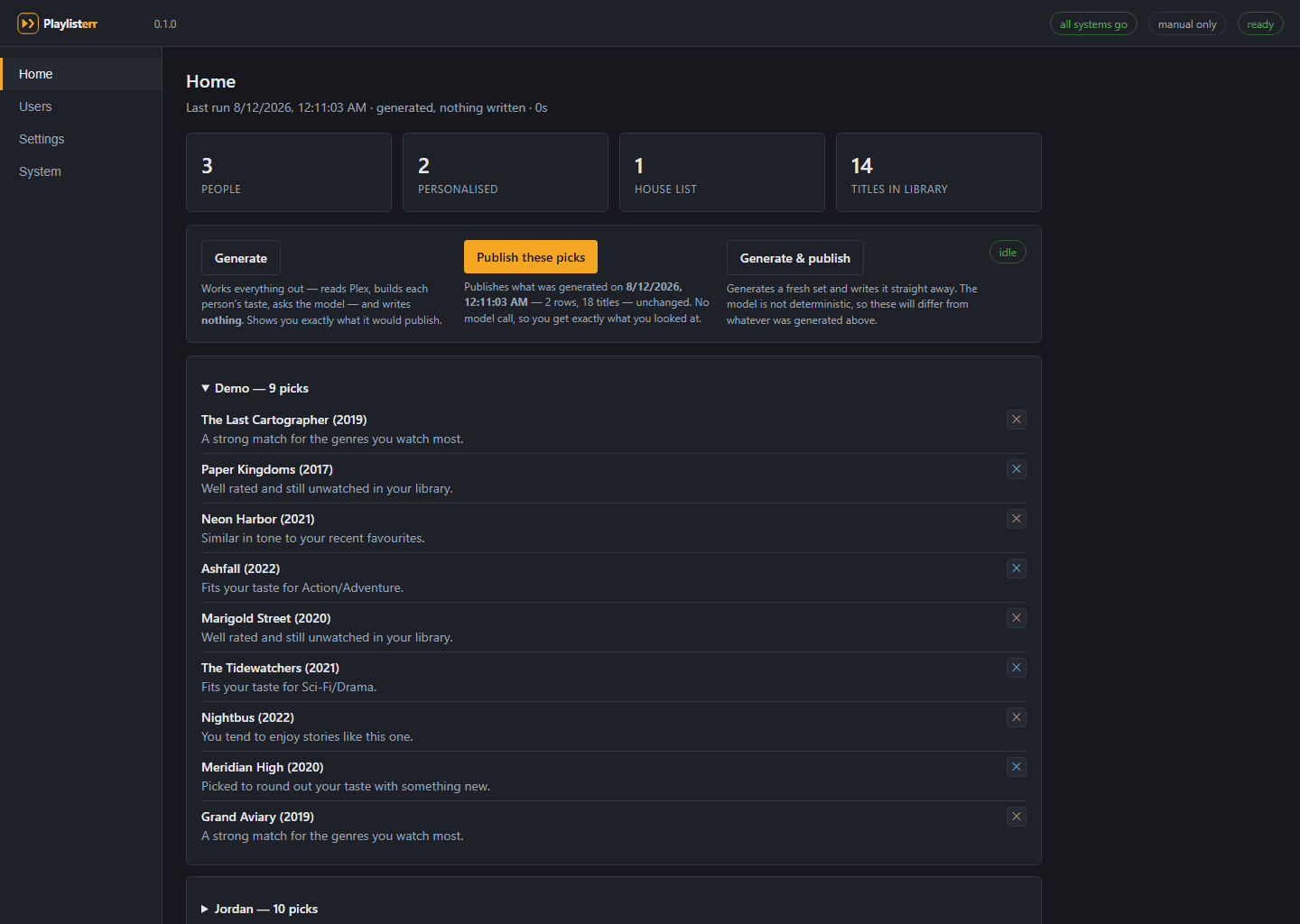
Every row explains itself
Because in Movies you've been watching The Long Ferry, Glass Orchard and The Quiet Engine, and you tend to go for drama and mystery, we thought these might be a good match.
- • The Last Cartographer (2019): a strong match for the genres you watch most
- • Paper Kingdoms (2017): well rated and still unwatched in your library
- • Neon Harbor (2021): similar in tone to your recent favourites
Picked for you on 12 Aug 2026 · refreshed nightly by Playlisterr.
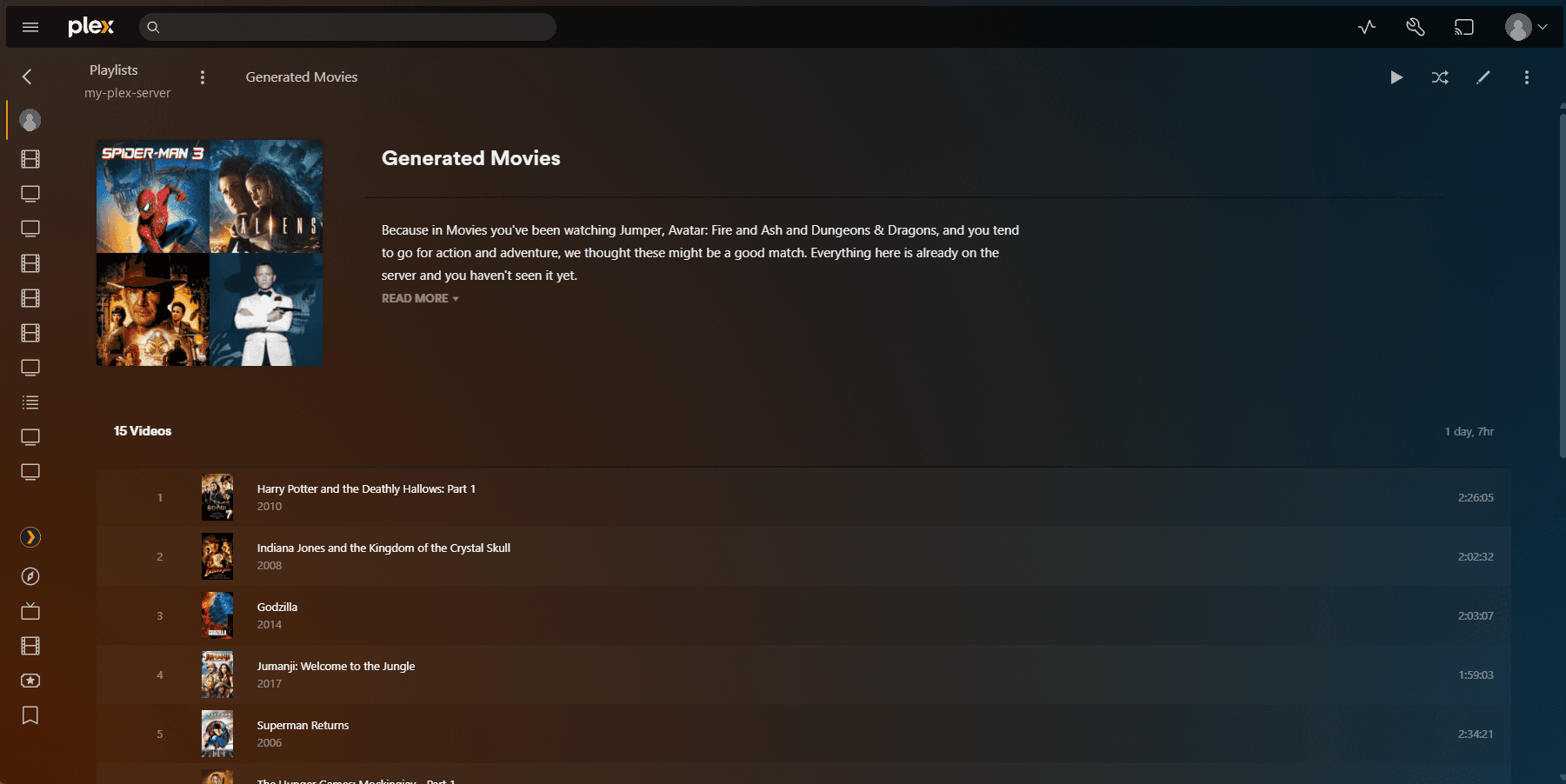
The same text, written straight into the playlist description in Plex. Each person sees only their own rows, the server owner included.
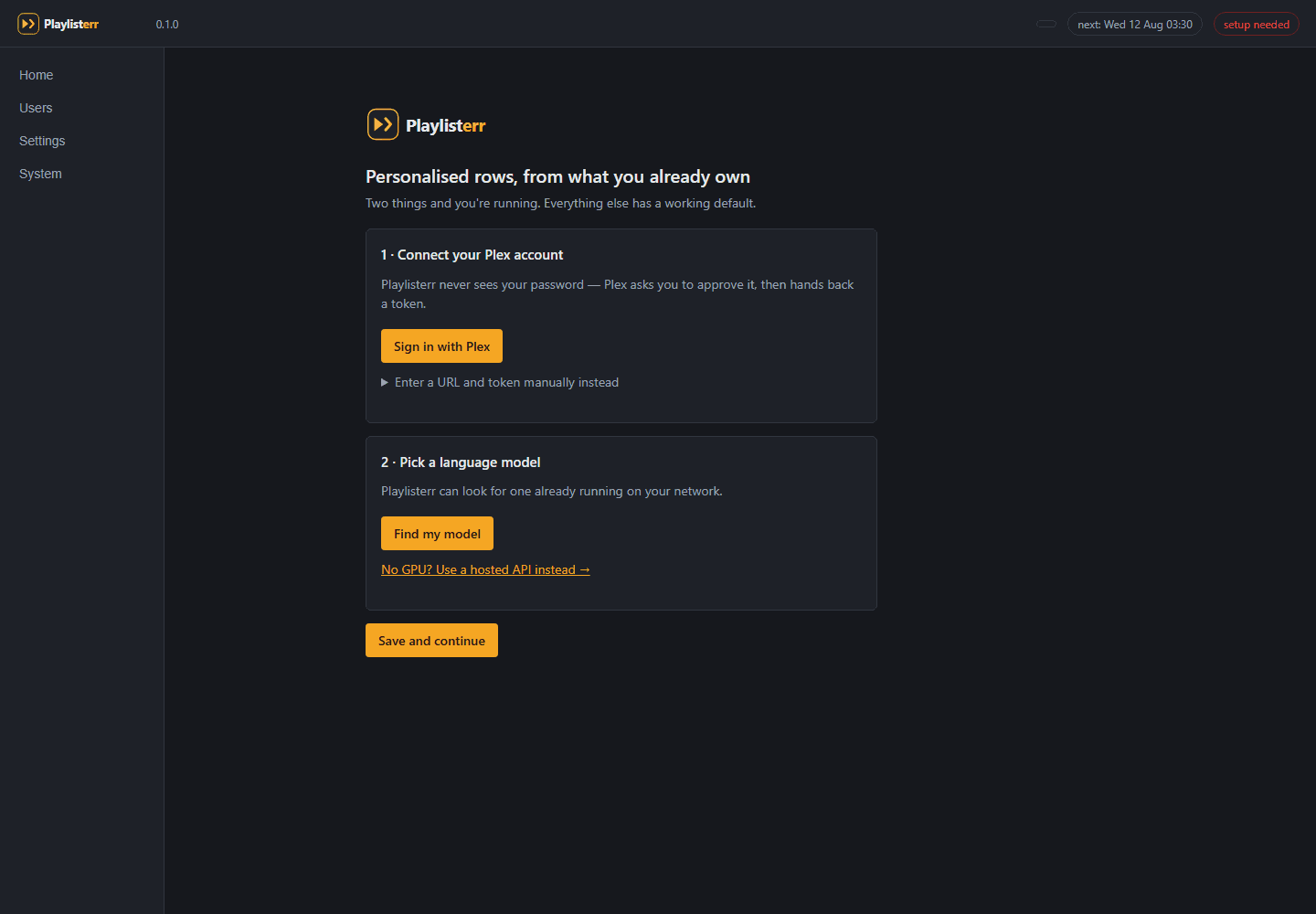
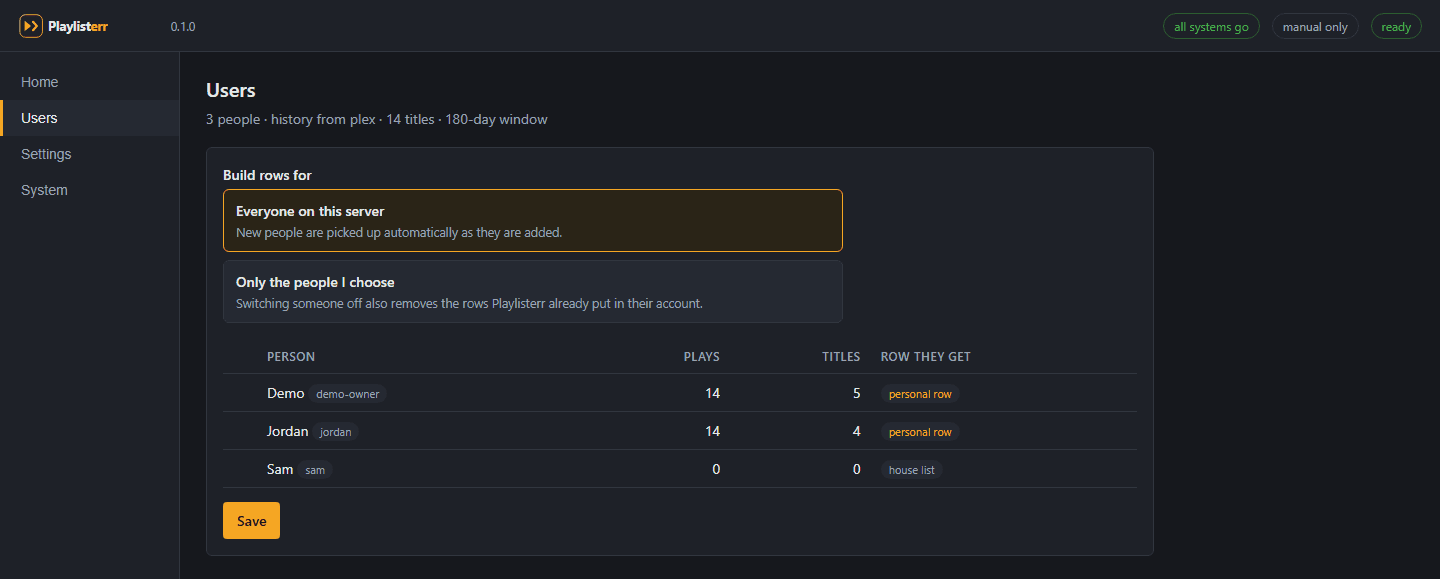
A web UI with no framework and no build step
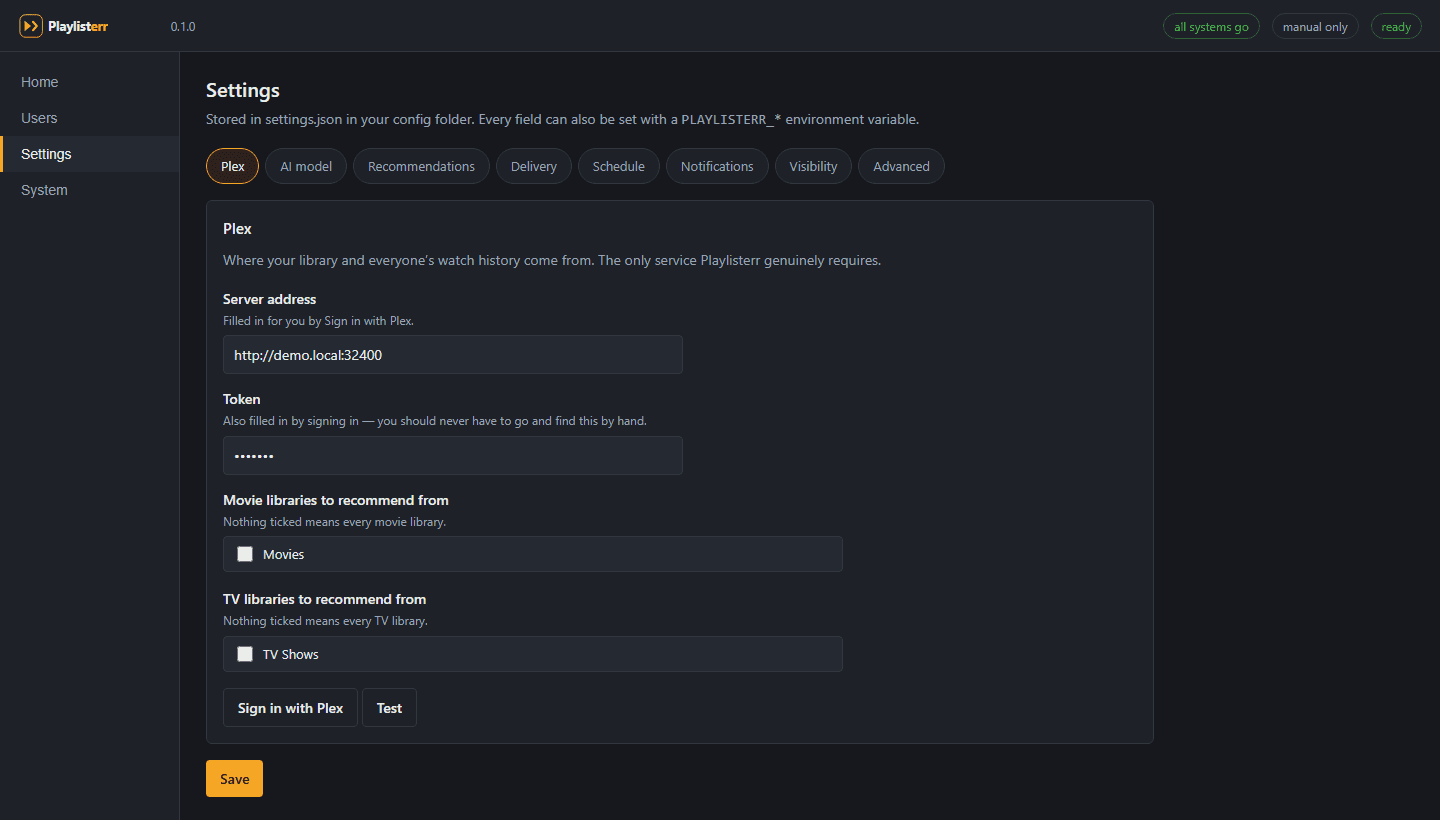
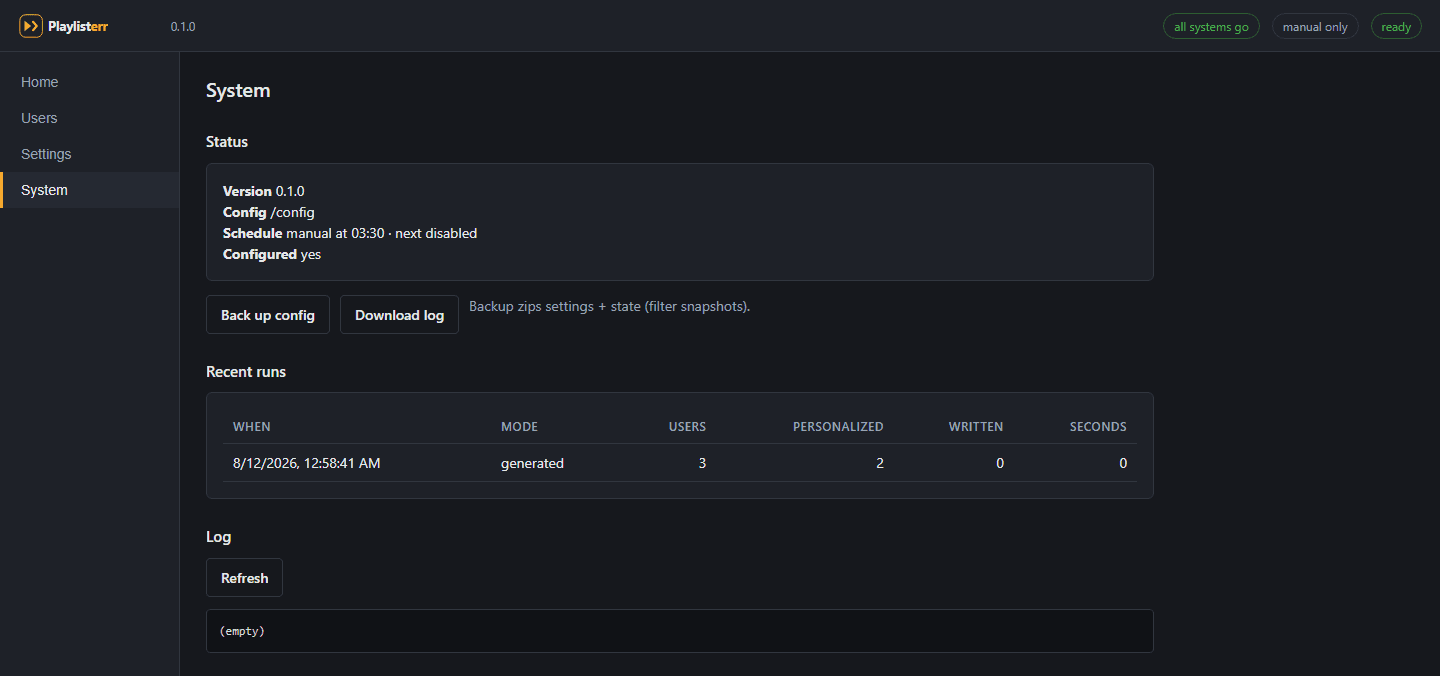
Choices made for the people who self-host it
Standard library only
No pip packages, ever. Dependencies are a tax on everyone who self-hosts, so the whole app is plain Python 3.11+ plus a vanilla-JS UI.
The model is on a short leash
Structured output where the endpoint supports it, validation against the candidate list regardless, and reasons checked for invented viewing history.
Private by default
Plex playlists belong to an account, so nobody sees anyone else’s picks. With a local Ollama, watch history never leaves your network.
Safe to run unattended
A nightly schedule, webhooks on success and failure, and a health panel so a dead model shows up now, not at 3am.
Writes only what it owns
Everything it creates carries its own label, and nothing without that label is ever touched. A plain run is a dry run.
Try it without Plex
Every checkout ships a fictional sample library, so the whole UI and pipeline run in demo mode with nothing real contacted.
Everything a contributor needs, from day one
Playlisterr went public finished and working, and it has run on my own server every night since. The repo ships with the documents that make an open-source project easy to trust and easy to join.
Using it? I'd love to hear from you
Bug reports, feature ideas, or just “it works on my setup” all help decide what goes into the next release.